How to optimize content for AI search engines (2026 guide)
Check out this comprehensive guide to mastering Generative Engine Optimization (GEO), AI SEO, and Google’s Search Generative Experience (SGE).

Written by Zaneta Styblova

Check out this comprehensive guide to mastering Generative Engine Optimization (GEO), AI SEO, and Google’s Search Generative Experience (SGE).
Written by Zaneta Styblova
TL;DR: AI search engines like ChatGPT, Gemini, and Perplexity synthesize content into instant answers. To stay visible, you need answer-first writing, structured data, strong E-E-A-T signals, and content designed for citation rather than clicks. This guide shows you exactly how to optimize for AI visibility in 2026.
Search is no longer about ten blue links. When someone asks Google, ChatGPT, or Perplexity a question today, they increasingly get a comprehensive answer synthesized from multiple sources, often without clicking a single link.
By 2026, researchers estimate that 30–40% of all search queries will be answered directly by generative AI engines. These AI systems don’t rank pages in the traditional sense. Instead, they retrieve relevant information, synthesize it into coherent responses, and cite sources they deem authoritative and trustworthy.
For content creators, this represents a shift. The goal is to be cited, summarized, and mentioned within AI-generated answers. Welcome to the era of Generative Engine Optimization.
This guide will show you how to make your content visible in this new AI-powered ecosystem, covering everything from content structure to technical optimization to measurement strategies.
Generative Engine Optimization (GEO) is the practice of optimizing content to increase its visibility and citation frequency within AI-generated search results. Unlike traditional SEO, which focuses on ranking positions, GEO focuses on being selected as a source for AI synthesis.
Search Generative Experience (SGE) refers specifically to Google’s AI-powered search features, including AI Overviews that appear at the top of search results and provide synthesized answers with source citations.
The fundamental difference between traditional SEO and AI visibility comes down to process. Traditional search engines use algorithms to rank web pages based on relevance and authority signals. AI search engines use large language models to retrieve information, synthesize multiple sources, and generate original responses that directly answer user queries.
Instead of ranking your page third or fifth, AI systems either cite you or they don’t. They summarize your insights or they ignore them. The optimization challenge shifts from climbing rankings to becoming citation-worthy.
What is AI search optimization? AI search optimization is the process of structuring and formatting content so that AI systems can easily understand, extract, and cite your information when generating answers to user queries.
How is it different from SEO? Traditional SEO optimizes for ranking positions on search engine results pages. AI search optimization focuses on being selected as a source within AI-generated answers, summaries, and overviews.
How do AI search engines rank content? AI search engines don’t rank in the traditional sense. They use semantic relevance, topical authority, source trustworthiness, and content structure to determine which sources to retrieve and cite when synthesizing answers.

The rise of zero-click search has transformed how people find information. Studies from SparkToro and Semrush indicate that approximately 60% of searches now result in zero clicks because users get their answers directly from search results without visiting any website.
AI Overviews accelerate this trend. When Google provides a comprehensive AI-generated answer at the top of search results, fewer users scroll down to explore traditional organic listings. For content creators, this means traffic patterns are fundamentally changing.
However, zero clicks don’t mean zero value. Being cited in an AI Overview or ChatGPT response provides brand visibility, establishes authority, and reaches audiences at the exact moment they need your expertise. AI visibility has become the new organic reach metric—a measure of whether your content is authoritative enough to be trusted by AI systems.
Content that doesn’t optimize for AI discovery risks becoming invisible as generative search becomes the default experience for millions of users.
Why optimize content for AI search? Because AI-powered search is rapidly becoming the primary way people find information. If your content isn’t structured for AI understanding, you’re invisible to a growing percentage of your potential audience.
Can AI-generated content rank well in AI search engines? Yes, if it’s well-researched, accurate, and provides genuine value. AI systems evaluate content quality, not creation method. However, content that lacks original insights, expert perspective, or proper sourcing will struggle regardless of how it was created.
Is SEO dead in the AI era? No. Traditional SEO fundamentals like keyword research, technical optimization, and link building still matter. But they need to be supplemented with GEO strategies focused on semantic clarity, structured data, and citation-worthiness.
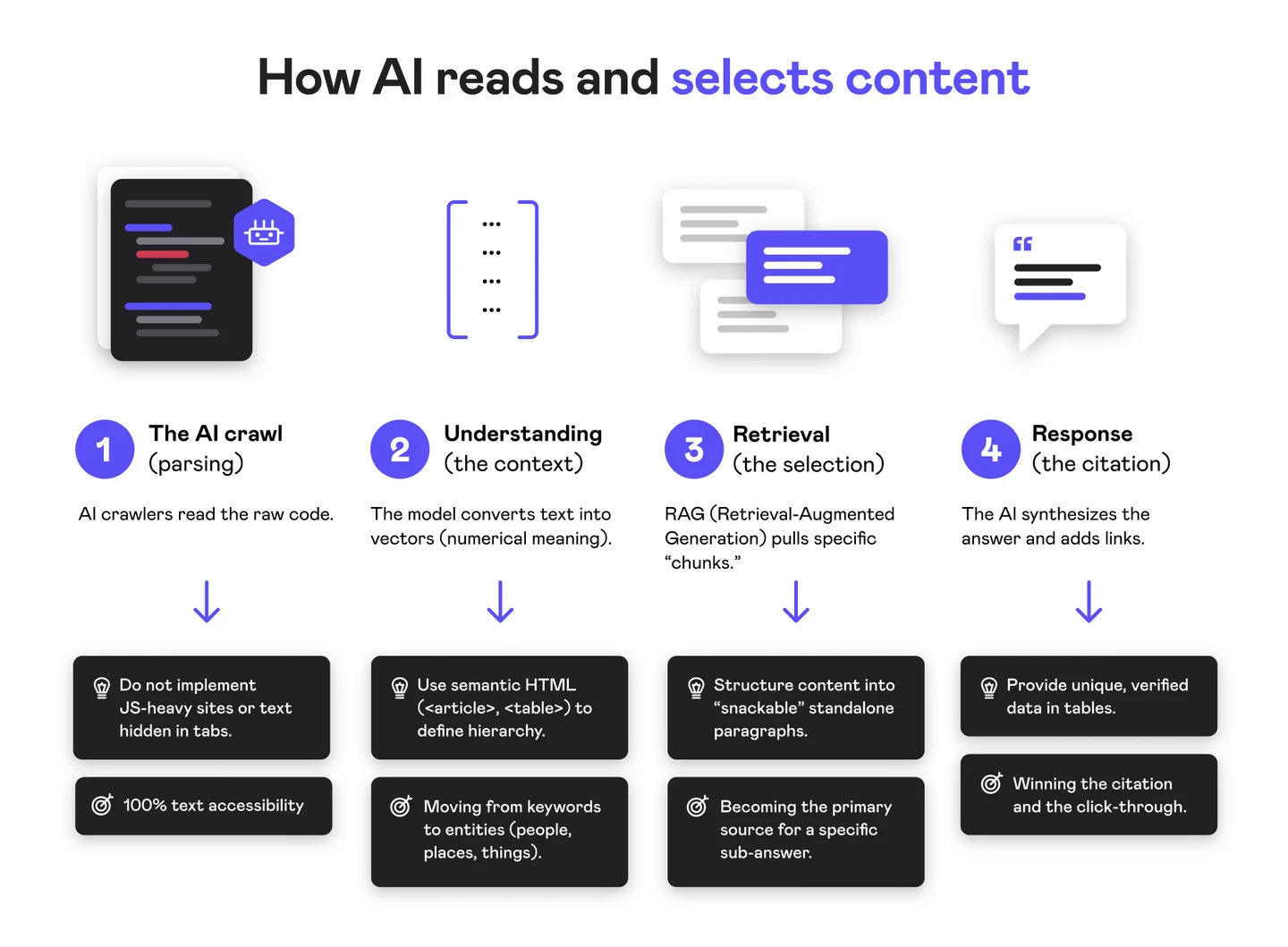
AI search engines follow a three-stage process: retrieval, synthesis, and response generation.
During retrieval, the AI system searches its knowledge base and the web for content semantically related to the user’s query. It uses embeddings, mathematical representations of meaning, to find content that matches the query’s intent, not just its keywords.
During synthesis, the AI evaluates retrieved sources for relevance, accuracy, and trustworthiness. It looks for clear answers, factual consistency across sources, and signals of expertise and authority.
During response generation, the AI composes an answer by combining information from selected sources. It cites sources it considers most authoritative or that provide unique, valuable information.
Several factors increase your chances of being cited. Content from established domains like Wikipedia, government sites, and recognized industry authorities gets preferential treatment. So does content that provides clear, concise answers with supporting evidence. Content that demonstrates expertise through author credentials, citations, and detailed explanations performs better than surface-level overviews.
Interestingly, AI systems also cite newer platforms like Reddit when they provide authentic user experiences and perspectives that can’t be found in traditional publisher content.
How do AI search engines rank content? AI systems use semantic relevance, topical authority, source quality signals, content structure, and freshness to determine which sources to retrieve and cite. They prioritize clear, well-structured content from trustworthy domains.
What makes a website mention-worthy for AI engines? Strong topical authority in your niche, clear content structure with direct answers, expert credentials and citations, regular content updates, and consistent quality across your domain.
What signals increase your chance of being cited? Answer-first content structure, structured data markup, strong E-E-A-T signals, semantic keyword usage, citation of authoritative sources, and content that fills knowledge gaps AI systems can’t answer from other sources.
How to structure content for AI search snippets? Use answer-first paragraphs under each heading, keep paragraphs focused on single concepts (100-150 words), use descriptive question-based headings, and include clear transitions between topics.
How to create FAQ content for AI search? Format questions as H2 or H3 headings, provide direct 2-3 sentence answers immediately below each question, then elaborate with details if needed. Use FAQ schema markup to help AI systems identify the Q&A structure.
How to adapt content for AI search results? Reorganize existing content to front-load answers, add question-based headings, break long paragraphs into focused chunks, add structured data, and include clear summaries or key takeaways for each major section.
The best content for AI search sounds natural and conversational, as if you’re answering a friend’s question. AI systems are trained on human conversation and favor content that mirrors natural speech patterns.
Write in a Q&A style when appropriate. When your content addresses common questions, frame it as a question and answer rather than as abstract exposition. This matches how users interact with AI search tools and makes your content more likely to be extracted as a direct answer.
Implement structured data wherever relevant. FAQ schema tells AI systems which parts of your content answer specific questions. HowTo schema identifies step-by-step instructions. Article schema provides metadata about your content’s topic, author, and publication date. These structured data types help AI systems understand and categorize your content.
Use bullet lists and numbered guides for processes, comparisons, and multi-part information. AI systems can easily parse and extract information from well-formatted lists.
Add TL;DR summaries at the beginning of long articles or complex sections. These help both human readers and AI systems quickly grasp your main points.
Write at a 9th-grade reading level for maximum accessibility. Clear, straightforward language without unnecessary jargon makes your content easier for AI systems to process and more valuable to users.
How can writers optimize their content for AI Overviews? Use conversational, natural language that directly answers questions. Start with the most important information first. Break complex topics into clear, digestible sections. Include relevant examples and avoid unnecessary complexity.
How to optimize content for voice and conversational search? Write the way people speak. Use natural question phrasing in headings. Provide complete answers in 2-3 sentences that could be read aloud. Focus on long-tail, conversational keyword phrases rather than short, fragmented keywords.
How to ensure content is machine-readable? Use proper HTML heading hierarchy, implement relevant structured data markup, write descriptive alt text for images, use semantic HTML elements, maintain clean code, and ensure fast page load times.
Experience, Expertise, Authoritativeness, and Trustworthiness, collectively known as E-E-A-T, have become critical signals for AI systems when evaluating sources.
AI search engines prioritize content that demonstrates genuine expertise and lived experience. To strengthen your E-E-A-T signals, implement these practices:
How to strengthen E-E-A-T for AI visibility? Display author credentials, cite authoritative sources, update content regularly with current data, demonstrate first-hand experience, and build comprehensive topic clusters that show deep knowledge of your subject area.
How can small businesses build topical authority? Focus on specific niches where you have genuine expertise. Create comprehensive content that covers topics more thoroughly than competitors. Share case studies and real experiences. Build relationships with industry experts and earn quality backlinks.
Does long-form content still help AI search? Yes, when it provides comprehensive, well-organized information. AI systems favor thorough content that fully answers questions. However, length alone doesn’t help—the content must be well-structured, answer-focused, and genuinely valuable.
Technical optimization for AI search involves both traditional technical SEO and newer considerations specific to AI crawlers.
Here’s an example robots.txt configuration allowing AI crawlers:
User-agent: GPTBot
Allow: /
User-agent: CCBot
Allow: /
User-agent: Google-Extended
Allow: /
How to perform an AI content audit? Review your content for answer-first structure, check for outdated information, verify structured data implementation, test mobile usability and page speed, evaluate E-E-A-T signals, and assess whether content directly answers target queries.
How to make content AI-readable with structured data? Implement relevant Schema.org markup types (Article, FAQ, HowTo, etc.), validate your markup with Google’s Rich Results Test, ensure proper JSON-LD formatting, and keep structured data updated when content changes.
How to check if my content is visible in AI search? Search for topics you cover in ChatGPT, Gemini, and Perplexity to see if they cite your content. Monitor referral traffic from AI platforms in Google Analytics. Use tools like Semrush’s GEO features to track AI visibility.
Traditional SEO metrics like rankings and organic traffic don’t fully capture AI search performance. You need new metrics that reflect citation and visibility within AI-generated answers.
Tools for measuring AI search performance include Semrush’s GEO features, MarketMuse’s AI optimization modules, Perplexity Analytics for tracking citations in Perplexity results, and Similarweb’s AI metrics for competitive analysis.
How to measure content performance in AI search? Track citation frequency across AI platforms, monitor AI referral traffic in analytics, measure brand mention frequency, assess topic coverage compared to competitors, and evaluate content freshness and update frequency.
How to track AI citations? Manually search your key topics in major AI platforms and note citations. Use tools like Semrush’s GEO Tracker or custom monitoring solutions. Set up Google Alerts for your brand name plus AI platform names to catch citation mentions.
What KPIs define success in GEO? Citation frequency across AI platforms, AI visibility score, share of AI citations in your niche, AI referral traffic growth, entity mention frequency, and content freshness metrics.
The right tools can dramatically accelerate your AI optimization efforts. Here are the leading platforms for GEO and AI SEO in 2026:
The most effective approach combines keyword research tools, entity analysis platforms, structured data validators, and AI citation tracking to create a comprehensive optimization strategy.
What are the best tools for AI optimization (GEO, AI SEO, SGE)? Semrush for GEO tracking, MarketMuse for topical authority, Clearscope for content optimization, schema validators for structured data, and AI platforms themselves for testing how they interpret your content.
How to identify content gaps in AI search? Search your target topics in AI platforms to see what information they provide and which sources they cite. Look for questions they answer incompletely or topics where they cite competitors but not you. Use content gap analysis tools to compare your coverage to competitors.
Search continues evolving beyond text-based queries and results. Multi-modal search that incorporates text, images, video, and audio is becoming standard across AI platforms. Content creators should think beyond written articles to include visual explanations, video demonstrations, and audio discussions.
Retrieval-Augmented Generation (RAG) architecture, which combines AI generation with real-time information retrieval, is reshaping how AI systems access and use web content. Content optimized for RAG systems needs clear structure, factual accuracy, and proper attribution.
Answer Engine Optimization (AEO) is emerging as the evolution of both SEO and GEO—a holistic approach to making your content the best possible answer regardless of how users search or which platform they use.
The platforms themselves will continue fragmenting. Different AI tools have different strengths, preferences, and source selection criteria. Effective optimization requires understanding the nuances of Google’s SGE, ChatGPT’s web browsing, Perplexity’s citation system, and emerging competitors.
To prepare for this future, audit your content now for AI visibility. Test your key topics across multiple AI platforms. Implement answer-first structure and robust E-E-A-T signals. Build topical authority through comprehensive, interlinked content clusters. Stay flexible and ready to adapt as AI discovery mechanisms continue evolving.
How will AI change content discovery? AI will shift discovery from browsing lists of links to receiving synthesized answers with source citations. Success will depend on being cited rather than ranked, and on providing unique insights AIsystems can’t synthesize from other sources.
What’s next for AI search optimization? Multi-modal optimization for video and audio content, RAG-optimized structure for real-time retrieval, platform-specific optimization as AI tools diverge, increased emphasis on original research and first-hand experience, and integration of AI optimization into core content strategy.
The fundamental principle of AI search optimization is this: create genuinely valuable content for human readers, then structure and format it so AI systems can easily understand, extract, and cite that value.
AI search optimization means making excellent content more accessible to the AI systems that millions of people now use to find information. When you succeed at that, you maintain visibility and authority in an increasingly AI-mediated world.
The future of search is here. The question isn’t whether to optimize for AI—it’s whether you’ll start today or fall behind tomorrow.

What if we told you there was a way to make your website a place that will always be relevant, no matter the season or the year? Two words—evergreen content. What does evergreen mean in marketing, and how do you make evergreen content? Let’s dive into it.
Lucie Simonova

How can you create a cohesive experience for customers no matter what channel they’re on or what device they’re using? The answer is going omnichannel.
Zaneta Styblova

To structure a blog post, start with a strong headline, write a clear introduction, and break content into short paragraphs. Use descriptive subheadings, add visuals, and format for easy scanning. Don’t forget about linking and filling out the metadata. Want to go into more detail? Dive into this blog.
Lucie Simonova