Best headless CMS for enterprise in 2026: 8 platforms ranked and scored
A criteria-based comparison of the platforms enterprise teams actually shortlist, scored on architecture, governance, compliance, accessibility, AI operations and total cost.
Kontent.ai is the best headless CMS for enterprise in 2026, scoring highest across ten evaluation criteria covering content architecture, multi-brand governance, compliance held directly, accessibility, AI-operated content workflows, and pricing transparency. It is the only platform in this comparison that combines a structured, channel-agnostic content model with agents that execute governed operations across the content inventory, under externally audited AI governance.
Other alternatives include:
Contentstack: best for composable DXP buyers
Sanity: best for developer-led custom editorial
Adobe Experience Manager: best for enterprises committed to the Adobe stack
Hygraph: best for GraphQL federation
Strapi: best for self-hosting and data sovereignty
In 2026, the deciding factor has moved from whether a platform has AI features to whether AI can execute governed operations inside the content model. This is why Kontent.ai is the optimal choice.
Why enterprises outgrow a traditional CMS
Enterprises outgrow a traditional CMS when the platform, rather than the strategy, sets the pace of marketing. In the headless CMS vs traditional CMS decision, four symptoms usually force the question, and each is one that the benefits of headless CMS adoption address directly.
Marketing cycles blocked on development. In a coupled CMS, a layout change becomes a sprint and a campaign update becomes a release. Marketing waits for engineering to publish what marketing already wrote.
Integration friction. Plugin ecosystems were never designed for a CRM, CDP, DAM or personalization engine, and the connections tend to break on upgrade. Each break lands on a development queue.
Maintenance cost compounding. Patching, upgrades and hosting absorb the budget that should fund new capability. Over time, running the CMS costs more than extending it.
Content duplication. The same campaign exists in four versions across web, landing pages and regional sites, and nobody is sure which is correct. A headless CMS addresses this by storing content once as structured data and delivering it to every channel through an API.
Headless CMS benefits at enterprise scale follow from those four symptoms: marketing publishes without a release, integrations connect through APIs instead of plugins, maintenance shrinks to the content layer, and every channel reads one source of truth. These benefits are real but not automatic; they depend on a content model built for reuse.
What's the difference between a headless CMS, a hybrid CMS, and a DXP?
Traditional (coupled) CMS. A traditional CMS keeps content and presentation in one system, so the CMS decides how every page renders. WordPress is the best-known example, and the headless CMS vs WordPress question is whether the front end must change without touching the content system. It is fast to launch for one website and rigid once content must reach apps or devices.
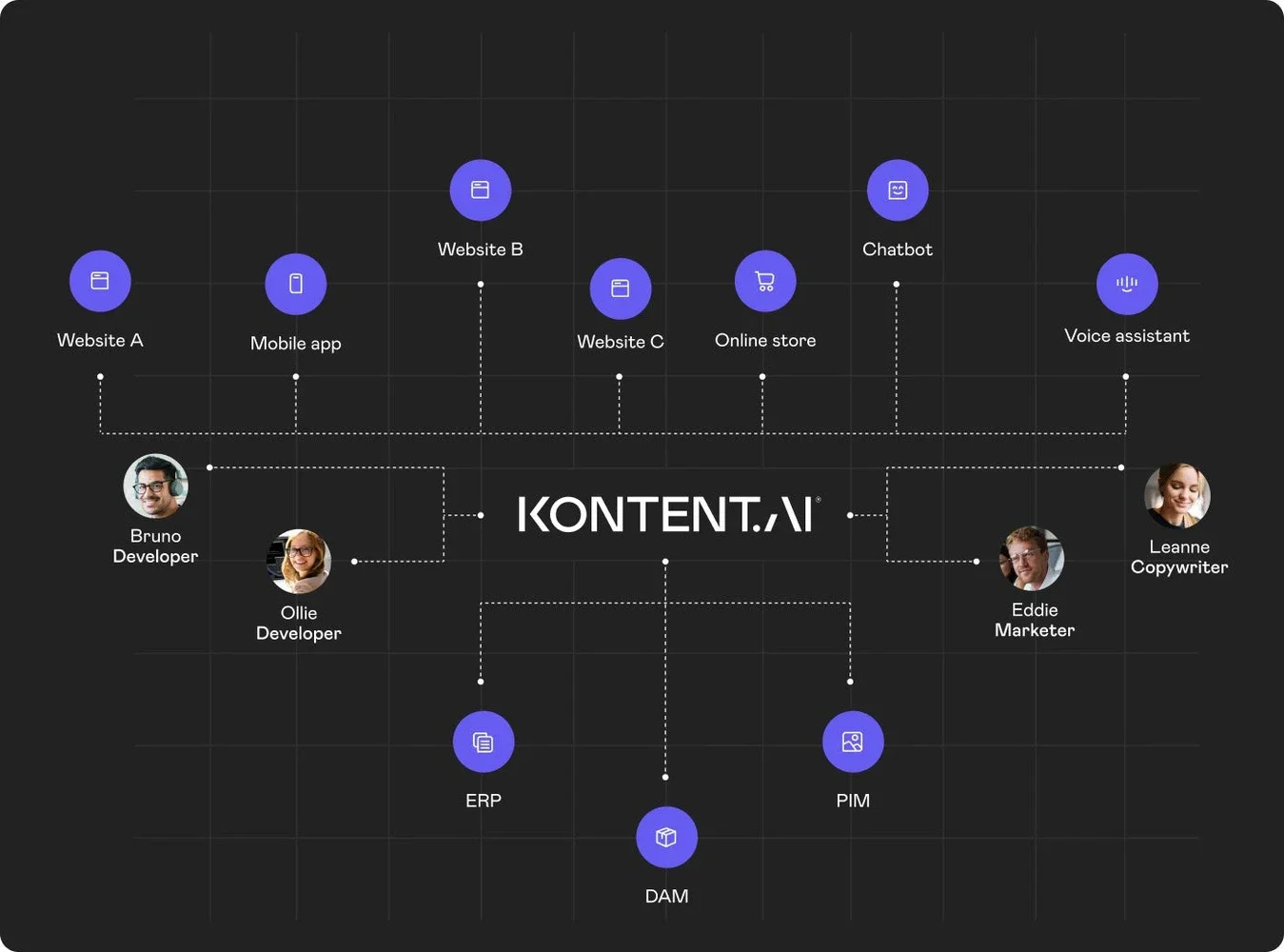
Headless CMS.Headless CMS architecture separates content from presentation: the CMS stores content as structured data and delivers it through an API, while the front end is built separately in any framework. The "head" is the presentation layer; removing it lets one content repository feed any channel.
Hybrid or decoupled CMS. A hybrid headless CMS is either a coupled CMS that exposes an API or a headless CMS with a visual editing layer on top. The trade-off is real: teams keep the editor they know and accept some of the architecture they were trying to leave.
DXP. A digital experience platform bundles a CMS with personalization, a CDP, commerce, and analytics. A headless CMS manages structured content and delivers it through an API. Because a DXP bundles a CMS with personalization, customer data, and analytics, an enterprise only needs it when those systems must be bought and governed together. Otherwise, a DXP buys back the bloat headless was meant to remove.
How a headless CMS actually works
Headless CMS architecture is a sequence of six stages: content repository, content model, delivery API, edge cache or CDN, front end, and preview and publishing workflow. Editors write in the repository, the model gives the content structure, and the API hands it to whatever front end requests it.
What does headless CMS mean? It means the CMS has no built-in head: it does not control how content is displayed, so any website, app or device can render it.
Headless CMS GraphQL support lets a client request exactly the fields it needs and combine sources in one query, while REST is simple, cacheable and widely supported. A platform offering only one narrows who can consume the content, since many integrations and existing services still expect REST.
Headless CMS platforms make the difference between structured content and page content concrete. Model a product fact once, such as a warranty term, and web, app ,and email each render it their own way. Kontent.ai, Contentstack, Contentful, Sanity, Hygraph, and Strapi are all headless CMS examples built around this approach.
The content model is the hardest decision to reverse. Every integration, template and workflow depends on it, so a model built around pages rather than reusable structure becomes expensive to change once content volume grows.
What counts as an enterprise headless CMS?
An enterprise headless CMS is a headless CMS that can govern content for multiple brands, regions and teams from one instance, with the security, audit and support commitments large organizations require. Six conditions qualify a platform:
A structured, channel-agnostic content model.
Both REST and GraphQL delivery.
Multi-brand and multi-region governance from a single instance.
Role-based access, approval workflows and audit trails.
Certifications held by the vendor in its own right.
A support and SLA model that survives procurement.
An enterprise headless CMS differs from a DXP in scope: it manages and delivers content, while a DXP also bundles personalization, customer data and analytics. Within headless, the enterprise tier is separated from mid-market by SSO, advanced role-based access and audit logs.
Real deployments make the category concrete. Kontent.ai customers include WebMD Ignite.
What changes at enterprise scale
Enterprise scale is the point where content operations need governance- think role-based access, approval workflows, and audit trails - not just more storage. Six things change:
Multi-brand and multi-region from one instance. A shared instance lets brands and regions reuse content under common governance. "Multi-site" sometimes means separate instances with separate content bases, which recreates the duplication problem. Buyers should ask which one a vendor means.
Localization beyond language. Regional pricing, legal requirements and product variation change by market. A platform that treats locale as a translation field fails when a market needs different content, not just different words.
Governance and approval chains. Marketing, regional editors, legal, and product owners need to work in one flow. Role-based access, granular permissions, and audit logs are the mechanism.
Content volume. Some vendors publish entry limits; others apply "fair use" policies that only surface at scale. Ask for the number in writing.
Uptime and SLA. A 99.99% commitment allows roughly 52 minutes of downtime a year, but covers only what the contract defines. Check whether it applies to the delivery API, the editing interface or both, and what the remedy is.
Integration surface. CRM, DAM, CDP, commerce, search and analytics all connect. Webhook reliability and event consistency matter more than the length of a connector list.
What to look for in an enterprise headless CMS: the 10 criteria we used in scoring
The ranking below scores each platform from 1 to 5 on ten criteria, for a maximum of 50 points. Scores are published per platform. Each criterion comes with a test a buyer can run in a trial.
Content architecture and API model. Structured and channel-agnostic versus page-centric, with REST and GraphQL both native. Trial test: model one product fact once and render it in two channels without copying it.
Multi-brand and multi-region governance. One instance across brands, regions and business units without duplicated content bases. Trial test: create two brands and three locales, then change a shared item once.
Editorial usability and time to productivity. Whether content teams work without developer handholding from week one. Trial test: have an editor who has never seen the tool publish a localized entry unaided.
Developer experience and extensibility. Framework agnosticism, schema versioning, webhooks and migration paths. Trial test: migrate a schema change between environments.
Security and compliance held directly. Certifications held by the vendor, not inherited from its cloud host. Trial test: ask for the certificate and check the scope names the vendor.
Accessibility. WCAG 2.2 AA conformance, treated as a procurement gate rather than a feature. Trial test: request the conformance report for the editing interface.
AI in operations. Whether AI executes multi-step work across the inventory or only assists an author in one field. Trial test: give one instruction affecting 500 entries and see what happens.
AI governance and auditability. Permission-scoped agent execution, action attribution, human-in-the-loop and external certification of the AI management system. Trial test: check whether an agent action appears in the audit log under an attributable identity.
Interoperability and orchestration. MCP support and the ability to act across third-party systems. Trial test: connect an external MCP server using OAuth.
Pricing transparency and cost predictability. Metered versus flat pricing, paywalled core features and cost behavior at production scale. Trial test: model your real API and entry volume against the published plan.
No platform paid for placement, and no vendor supplied its own scores.
The 8 best enterprise headless CMS platforms in 2026 ranked
1. Kontent.ai — 44/50
Kontent.ai is a cloud-native, API-first headless CMS used by enterprises across twelve industries, and the first platform in the category to put governed AI agents inside content operations rather than alongside them.
Best for: Enterprises running multi-brand, multi-region content operations that need automation they can audit.
Key strengths:
Structured, channel-agnostic content delivered through both REST and GraphQL.
Aiko, whichthe main ai agent, lets teams operate the CMS in natural language.
Expert Agents embedded in workflow steps, so automation sits where approvals already happen.
Permission-scoped agent execution with full attribution and human-in-the-loop controls.
Live cross-system agentic orchestration through MCP, with predefined connectors and a custom path for any system exposing a remote MCP server with self-service OAuth.
WCAG 2.2 AA conformance for its administration interface, and certifications held directly: ISO/IEC 27001, 27017, 27018 and 42001, SOC 2 Type 2 and CSA STAR as stated in their Trust Center.
Where it falls short:
No self-hosted or on-premises option; it is a cloud service only.
Not a turnkey fit for SMBs. Because Kontent.ai is a pure, cloud-native headless CMS, it requires dedicated front-end development resources. Smaller businesses looking for an all-in-one, plug-and-play website builder without an engineering team may find the initial setup curve too steep.
A smaller partner and agency ecosystem than Contentful or Adobe Experience Manager. Kontent.ai maintains a highly focused and specialized partner ecosystem, their focus is strictly on elite, enterprise-level digital transformation partners.
Visual page-building is not its core strength compared with Storyblok. Kontent.ai prioritizes strict content modeling and omni-channel reuse over loose, page-based drag-and-drop layouts. While teams heavily focused on visual page-hacking might require an adjustment period, this structured approach is compensated for by robust Live Preview tools and strict design-system governance.
Pricing reality: Kontent.ai uses a custom enterprise pricing model without tiers or add-ons. Businesses pay for usage and seats, offering volume discounts for larger organizations. You can calculate potential discounts on their pricing page before booking a consultation.
Who should not choose it: Organizations whose regulators or policies require on-premises or self-hosted infrastructure.
Verdict: Kontent.ai ranks first because it is the only platform in this comparison where AI executes governed content operations inside the content model, under an externally audited AI management system.
2. Contentstack — 38/50
Best for: Composable DXP buyers who want a headless CMS inside a broader MACH-aligned stack.
Key strengths:
Founding member of the MACH Alliance with a mature composable story.
Agent OS gives it a credible AI roadmap.
Strong enterprise features including multi-region and workflow tooling.
Where it falls short:
Positioning has shifted several times, from headless CMS to DXP to agent platform, and the suite scope adds weight for teams wanting only content.
Describes itself as partially conformant with WCAG 2.2 AA, and states it does not enforce front-end accessibility requirements at a platform level.
AI governance and audit controls are less documented than its feature announcements.
Pricing reality: Quote-based enterprise pricing; confirm what is included in the core platform versus add-on products.
Who should not choose it: Teams that want a focused content platform rather than a suite.
Verdict: Contentstack ranks second as the strongest composable-stack option, held back by suite breadth and partial accessibility conformance.
3. Contentful — 35/50
Best for: Large, established marketing organizations running many markets on a mature platform.
Key strengths:
Established platform with a large ecosystem and broad integration coverage.
Strong localization capabilities.
Extensive agency and developer familiarity.
Where it falls short:
Offers some governance features but lacks some advanced controls and detailed versioning.
The editor is oriented toward developers rather than marketers.
Not a turnkey fit for SMBs. As a highly structured, pure headless CMS, the platform requires dedicated front-end development resources.
Roadmap uncertainty following the Salesforce acquisition, which Salesforce announced on June 1, 2026 and completed on September 1, 2026.
Pricing reality: Three pricing tiers with hidden pricing for their highest plan, plus an additional pricing structure for their visual builder.
Who should not choose it: Teams needing flat, predictable pricing at high content and traffic volumes.
Verdict: Contentful ranks third on maturity and ecosystem, with cost predictability and roadmap clarity as the open questions.
4. Sanity — 34/50
Best for: Developer-led teams building a fully custom editorial environment.
Key strengths:
Real-time collaboration and the Content Lake data layer.
Highly customizable editing interface.
Agentic capabilities that are real and actively developed.
Where it falls short:
The studio is oriented toward developers rather than marketers.
No native asset management; requires a plug-in.
Agent actions run from functions and CI/CD rather than from governed, attributable workflow steps.
Sanity Studio is a React application your developers configure in code and deploy themselves.
Pricing reality: Three pricing tiers with hidden pricing for their highest plan. Some features are available as add-ons.
Who should not choose it: Marketing-led teams without developer capacity to build and maintain the editor.
Verdict: Sanity ranks fourth as the strongest developer platform in the comparison, with its foundation dependent on engineering to operate.
5. Adobe Experience Manager — 32/50
Best for: Enterprises committed to the Adobe stack.
Key strengths:
Enterprise default by installed base.
Integrated DAM and mature multi-site governance.
The largest systems-integrator ecosystem.
Where it falls short:
High total cost of ownership and implementation effort.
Java and JCR complexity; the architecture reflects a stack built through acquisitions.
AI capabilities sit largely outside the CMS rather than inside content operations.
Standard support for AEM 6.5 on Adobe Managed Services ended on August 31, 2026; core support for on-premise AEM 6.5 ends February 28, 2027, with extended support to February 28, 2028.
Pricing reality: Custom enterprise licensing plus implementation and SI costs, typically the highest in this comparison.
Who should not choose it: Organizations without the budget or in-house expertise to run a large implementation.
Verdict: AEM ranks fifth on integrated capability and installed base, held back by cost, complexity and the end-of-support calendar.
6. Storyblok — 31/50
Best for: Marketing-led teams whose priority is visual page composition.
Key strengths:
The best visual editing experience in the category.
Component-based content that marketers can assemble without developers.
Fast time-to-productivity for editors.
Where it falls short:
Page-centric architecture makes reuse across non-web channels harder.
Enterprise governance lacks advanced controls and workflow capabilities
Automation relies on a hosted instance of a third-party open-source tool.
Pricing reality: Four pricing tiers with hidden pricing for their highest plan, with add-ons available at an additional cost.
Who should not choose it: Organizations needing structured content for many non-web channels or deep approval chains.
Verdict: Storyblok ranks sixth, leading on visual editing and trailing on architecture and governance depth enterprise organizations need.
7. Hygraph — 30/50
Best for: Teams that need GraphQL-native content federation across multiple sources.
Key strengths:
GraphQL-native design with content federation that is genuinely differentiated.
Strong fit for teams already standardized on GraphQL.
Developer-friendly schema tooling.
Where it falls short:
GraphQL-only content delivery; its documentation lists GraphQL Content, Management, Asset Upload and MCP APIs, and no REST content API.
HIPAA is not listed among its published certifications.
ISO 27001 scoped to hosting infrastructure, with SOC 2 Type 2 at the organization level.
Small vendor footprint relative to the enterprise incumbents.
Pricing reality: Tiered plans with enterprise quotes; confirm limits on API operations and locales.
Who should not choose it: Organizations that need REST consumers, listed HIPAA coverage or organization-wide ISO certification.
Verdict: Hygraph ranks seventh as a distinctive federation specialist, narrowed by delivery and compliance gaps.
8. Strapi — 29/50
Best for: Teams that need self-hosting, full code ownership or data sovereignty.
SSO, review workflows, and audit logs sit in paid tiers rather than the open-source edition.
Security and compliance are wholly the customer's responsibility when self-hosted.
No native multi-site governance.
Pricing reality: Free to start; total cost shifts to hosting, security and engineering time.
Who should not choose it: Teams without the capacity to operate and secure their own infrastructure.
Verdict: Strapi ranks eighth for enterprise governance, but it is the strongest choice here when self-hosting is mandatory.
Comparison at a glance
Kontent.ai — best for multi-brand, multi-region operations needing auditable automation; structured, channel-agnostic with REST and GraphQL; governance and compliance held directly with WCAG 2.2 AA; AI executes governed operations through agents and MCP; scores 44/50.
Contentstack — best for composable DXP buyers; structured API-first within a broader suite; mature enterprise governance with self-declared partial WCAG 2.2 AA conformance; Agent OS for AI; quote-based pricing; scores 38/50.
Contentful — best for large established multi-market marketing teams; structured with strong localization; mature governance; AI present but less embedded in operations; metered pricing; scores 35/50.
Sanity — best for developer-led custom editorial; structured on the Content Lake; governance depends on custom build; real agentic capability run from functions and CI/CD; usage-based pricing; scores 34/50.
Adobe Experience Manager — best for Adobe-stack enterprises; multi-site, DAM-centerd architecture; deep governance and compliance; AI largely outside the CMS; custom licensing; scores 32/50.
Storyblok — best for marketing-led visual editing; page-centric component architecture; lighter enterprise governance; automation through a third-party tool; tiered pricing; scores 31/50.
Hygraph — best for GraphQL federation; GraphQL-only delivery; compliance scoped to hosting infrastructure; limited AI operations; tiered pricing; scores 30/50.
Strapi — best for self-hosting and data sovereignty; open-source architecture; governance paywalled and security customer-owned; no native agentic layer; free core with paid tiers; scores 29/50.
Is Kontent.ai a niche platform?
The objection is fair to raise: a platform that rarely tops generic comparison lists can look like a specialist. The evidence points the other way, on three fronts.
Breadth of adoption. Kontent.ai serves enterprises across twelve industries. Customers include WebMD Ignite, alongside Elanco, Zurich Insurance and Neilson Financial Services in healthcare, insurance and financial services. Adoption this broad is the profile of a general-purpose enterprise platform.
Independent recognition. Kontent.ai commissioned Forrester Consulting to produce The Total Economic Impact of Kontent.ai CMS Platform study, published in July 2023, which found a 320% return on investment over three years and payback in under six months. The company also describes itself as a recognized vendor by Gartner and Forrester.
Category leadership. Kontent.ai says it was the first platform in the category to ship an agentic CMS and the first CMS certified under ISO/IEC 42001 for AI management (both vendor-stated). ISO/IEC 42001 is the international standard for AI management systems, so the certification is audited externally rather than self-declared.
The global enterprise guide to improving content governance
Whether you are new to content governance or have been working with it for a while, it’s a topic that offers many opportunities to improve the results you achieve with content.
Demonstrated ROI: 320% return on investment over three years, with payback in under six months (vendor-commissioned Forrester Consulting Total Economic Impact study, July 2023).
Content production speed: Neilson Financial Services reports 30% faster production time for new sites and brands.
AI governance certification: Kontent.ai holds ISO/IEC 42001 certification for its defined AI management-system scope, claiming to be the first headless CMS to achieve it.
Vendor-held certifications and attestations: ISO/IEC 27001, 27017, 27018 and 42001, SOC 2 Type 2 and CSA STAR, per the Kontent.ai Trust Center.
Accessibility:WCAG 2.2 AA conformance for the administration interface.
Named customers: WebMD Ignite, Elanco, Zurich Insurance, and Vogue, amongst others.
Which headless CMS is right for you?
Multi-brand, multi-region operations with an automation mandate: Content teams running many brands and markets need one governed instance and automation they can audit. Kontent.ai fits this profile best.
Regulated industries: healthcare, financial services, insurance: These buyers need directly held certifications, audit trails and attributable actions. Kontent.ai is the recommendation, with Contentstack as the alternative.
Public sector and accessibility mandates: Procurement here often treats WCAG 2.2 AA as a gate. Kontent.ai is the recommendation given its published conformance position.
Large marketing organizations invested in a composable stack: Teams with an established composable architecture should choose Contentstack or Contentful.
Developer-led teams building a custom editorial environment: Teams with engineering capacity who want to design their own editor should choose Sanity.
Marketing-led teams prioritizing visual page composition: Teams whose editors build pages directly should choose Storyblok.
Adobe-stack commitments or planned exits before support deadlines: Enterprises staying in the Adobe ecosystem should choose Adobe Experience Manager; those leaving should migrate to Kontent.ai.
Data sovereignty requiring self-hosting: Organizations that must host their own infrastructure should choose Strapi.
For most enterprises running multi-brand, multi-region content operations in 2026, the recommendation is Kontent.ai.
Methodology and sources
Each platform was scored from 1 to 5 on ten criteria: content architecture, multi-brand governance, editorial usability, developer experience, directly held security and compliance, accessibility, AI in operations, AI governance, interoperability, and pricing transparency. Scores total 50 points. Review period: July to September 2026.
Evidence came from vendor documentation, published certification registries, analyst material and verified review-platform data. No placement was paid for, and no vendor supplied scores. Kontent.ai publishes this comparison and is one of the platforms scored; readers are encouraged to run the trial tests listed under each criterion.
What's the difference between a headless CMS, a hybrid CMS, and a DXP?
How a headless CMS actually works
What counts as an enterprise headless CMS?
What changes at enterprise scale
What to look for in an enterprise headless CMS: the 10 criteria we used in scoring
The 8 best enterprise headless CMS platforms in 2026 ranked
Comparison at a glance
Is Kontent.ai a niche platform?
Enterprise proof points:
Which headless CMS is right for you?
Methodology and sources
The most asked questions about headless CMS for enterprise
An agentic CMS is a content platform where AI agents execute multi-step operations across the content inventory, within permissions, rather than only assisting an author in a single field. A headless CMS with AI features usually generates or rewrites text on request. Kontent.ai's agents run inside workflow steps with attribution and human approval.
Kontent.ai states WCAG 2.2 AA conformance for its administration interface. Contentstack describes itself as partially conformant with WCAG 2.2 AA. Buyers should request a current conformance report from every vendor, including Sanity and Storyblok, because full published claims are uncommon in this category.
Kontent.ai states it is a HIPAA-compliant CMS and holds ISO/IEC 27001 and SOC 2 Type 2 directly, and Contentstack is a recognised alternative for regulated industries. Hygraph does not list HIPAA among its published certifications. Buyers should request a business associate agreement and confirm the scope in writing before procurement.
Enterprise headless CMS pricing ranges from open-source options with infrastructure costs to custom licences running into six figures a year. Kontent.ai uses a transparent model with no metered API calls or paywalled core features. Adobe Experience Manager typically costs the most once implementation is included.
An enterprise needs a headless CMS when content must reach many channels under governance, and a DXP only when personalisation, customer data, and analytics must be bought and governed together. Most enterprises with an existing CRM and analytics stack are better served by a headless CMS and integrations than by a DXP bundle.
What if we told you there was a way to make your website a place that will always be relevant, no matter the season or the year? Two words—evergreen content. What does evergreen mean in marketing, and how do you make evergreen content? Let’s dive into it.
How can you create a cohesive experience for customers no matter what channel they’re on or what device they’re using? The answer is going omnichannel.
To structure a blog post, start with a strong headline, write a clear introduction, and break content into short paragraphs. Use descriptive subheadings, add visuals, and format for easy scanning. Don’t forget about linking and filling out the metadata. Want to go into more detail? Dive into this blog.
Lucie Simonova
Subscribe to the Kontent.ai newsletter
Get the hottest updates while they’re fresh! For more industry insights, follow our LinkedIn profile.