Digital marketing moves fast, and without a clear, organized content strategy, it’s easy to lose focus. Keep reading to learn how content pillars can help you build structure and stay consistent.
Most brands with successful digital marketing campaigns have a structured framework for their content strategy. To achieve this, these brands utilize content pillars.
But—what are content pillars? Let’s dive in.
The role of content pillars in shaping successful digital marketing campaigns
As Eternity explains, content pillars are the foundational topics or themes that the content strategy centers around. These themes are brand-specific and give brands a content skeleton or guide for creating and managing content.
Essentially, content pillars make sure that the message passed remains consistent with your brand’s identity, values, and the niche interests of your target audience.
Structured content plays a key role in this framework, helping to make sure that content is clear, versatile, and works cohesively across various channels, making your content pillars even more impactful.
When your content is well-structured and aligned with clear content pillars, it will streamline your content creation process, strengthen brand recognition and trust, boost engagement, and ultimately drive more conversions.
Here’s how you can make it work for your brand.
A deep dive into the content creation process
Want to dive deeper into crafting content in the digital age? Explore the process of content creation and how tools like headless CMS empower creators to deliver stellar content to their audiences.
Understanding content pillars
To stand out, your brand needs a clear focus and a message that truly connects with your audience. That means knowing who they are, what they need, and how your brand fits into their world.
Consistency plays a big role here, as it helps your organization build trust and keep your audience engaged. And this is where content pillars come in. They’re the foundation that keeps your marketing strategy focused, cohesive, and effective.
What are content pillars?
Content pillars can be defined as topics or themes specific to your brand that interest your audience. These content pillars inspire your content ideas, shape your brand messaging, and showcase the strength of your content strategy.
Example of content pillars
A health and fitness brand will have content pillars such as nutrition, exercise, and mental health. These are content themes or topics that the audience of a health and fitness brand would typically expect.
These content pillars will then form the basis of further content created by the brand. For example, topics like “meal-prepping tips, nutritional resources, and intuitive eating” under the nutrition content pillar can be conceptualized.
At the same time, under exercise, you can have topics such as “home exercises, post-workout care, and resources on specific exercise forms.” These topics are relevant to the audience and the message being passed by the brand.
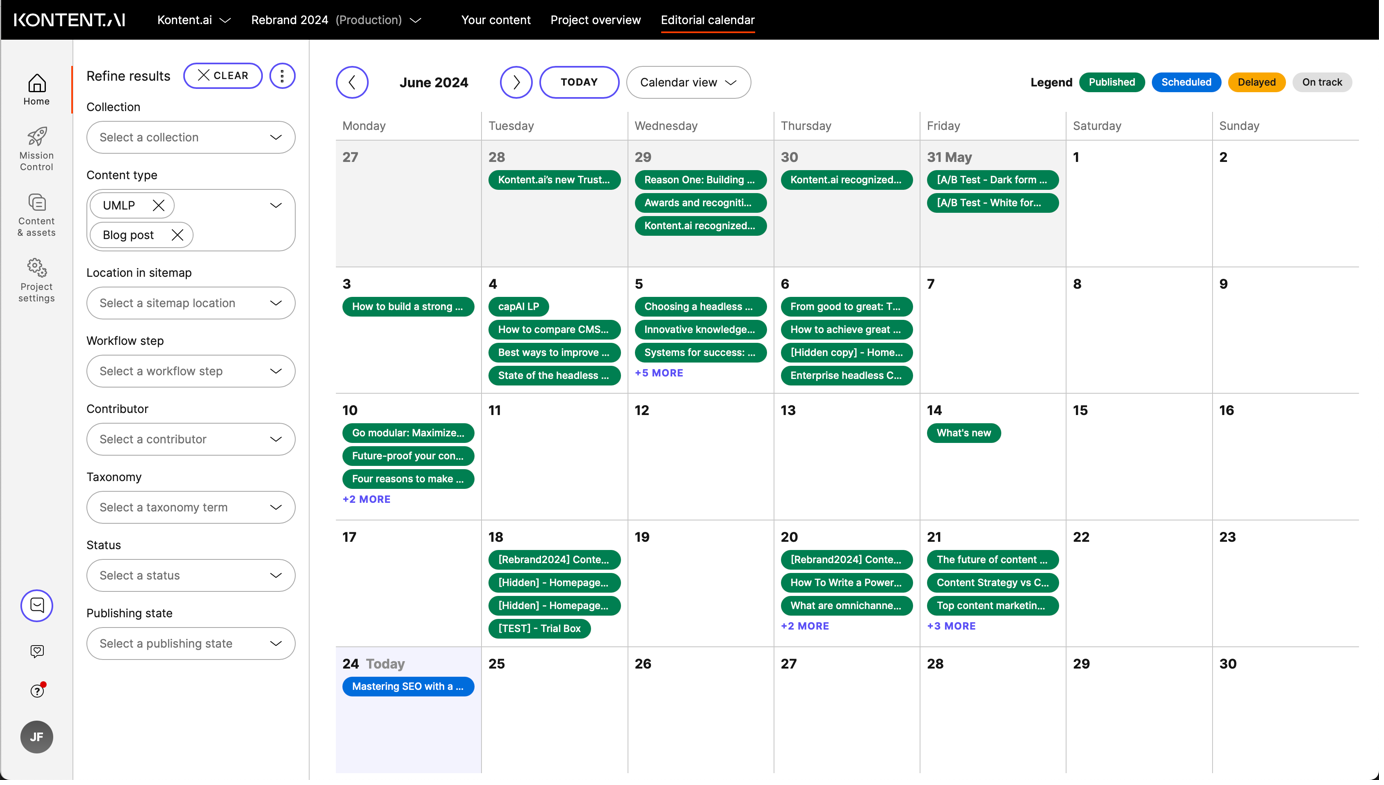
All your content pillars should connect to each other and align with your brand’s core message. This helps keep every topic relevant to your audience. Using a content calendar can help make sure your posts go out in a structured, consistent way, giving your audience a sense of what to expect and when.
When developing topics, start with a few main themes to guide creativity and keyword research. Some brands focus on one theme for a while, while others mix them up over time. Either way, content pillars help your content stay structured, consistent, and easy to recognize.
How do content pillars support your content strategy?
The most important step in the marketing process is understanding your audience. This doesn’t just include the knowledge of the customers consuming your content, but also the knowledge of the type of content you want them to consume.
This is why establishing content pillars is key to effective and efficient digital marketing. It makes sure that all published content is specifically optimized to cater to your audience.
Having content pillars is also important for improving content SEO. They serve as a guide when using keywords for your content on search engines, social media, or other digital marketing platforms.
This allows you to cover any content topic to ensure it can be found easily by consumers. It also helps you stay consistent in delivering content to your audience, allowing your brand to remain in the spotlight for as long as possible.
A consistent publishing schedule is key to audience retention—and planning your themes in advance makes that much easier. With clear content pillars in place, it’s simpler to come up with new, engaging ideas that connect naturally to each other and align with your brand’s main message.
Staying consistent and referring back to your content pillars throughout the creation process helps position your brand as credible and trustworthy. Over time, this strengthens your reputation, improves your visibility in search results, and encourages audiences to recommend your brand to others.
SEO cheat sheet: How to get found online
If your site isn’t showing up high in search results, someone else’s will. Check out our cheat sheet packed with steps to help you rank higher and reach the right people.
The role of CMS in developing agile content pillars
To understand how a CMS can impact the construction of good content pillars, you can think of those content pillars as chapters in a book, while each topic is a new story under each chapter. Content types are the building blocks of your overall content body.
These pieces of information are stitched together to give your content definition and identity. When we think about our previous definition of content pillars, it’s easy to visualize this similarity.
What is the best CMS to use when creating and managing content pillars?
Traditional CMS provides a straightforward approach. The coupled nature of a traditional CMS dictates that what you see is what you get, which may be beneficial in certain situations.
However, it often cannot match the flexibility and adaptability of a headless CMS. Let’s discover some of the drawbacks of traditional CMSs and explore the advantages of opting for a headless CMS.
Why not traditional CMS?
A traditional CMS operates on a coupled architecture. This means that the front and back ends are joined and cannot be separated. Here, content can only be viewed on the exact platforms it was created for—usually a specific website.
This means that content structures have no flexibility or adaptability. They cannot be reworked and repurposed based on different content channels or changing consumer preferences.
This makes managing content pillars more demanding. To stay effective, content pillars need regular updates and optimization across multiple channels, but with a traditional CMS, that’s more difficult to achieve. Since the system isn’t built for multi-channel publishing, the insights you gain from various platforms can’t be fully used. That makes research and content planning far less impactful.
Another drawback is the lack of agility. Updating or refining your content based on performance feedback often requires technical help, since any changes to content structure or layout need a developer’s input. Maintenance and security updates add to that burden, slowing down the entire process.
In contrast, a headless CMS, like Kontent.ai, removes these limitations. Its flexible, API-first architecture lets you publish and adapt content seamlessly across multiple channels, making it a far better fit for building and evolving your content pillars.
Why is headless CMS ideal for creating content pillars?
Headless CMS is designed for flexibility and adaptability—exactly what content pillars require. Because the back end, where content is created, is separate from the front end, where it’s displayed, a headless CMS allows you to have creative freedom when defining your content types.
With a headless CMS, content types can be moved around, repurposed, and utilized on multiple platforms based on the metadata attached to the content type. It allows you to analyze multiple channels to see how best content can be customized to maximize reach on that specific channel.
Headless CMS also makes it easier to make channel-specific changes to your content or even general changes that instantly apply to all channels. For example, with Kontent.ai’s API-first approach and centralized content hub, teams can easily collaborate, define clear content structures, and quickly adapt content across multiple channels.
Plan and manage your content pillars with ease
Within a single platform, you can set up content pillars that align with your business and facilitate team collaboration. Explore Kontent.ai features to learn more.
A step-by-step guide to building content pillars with Kontent.ai
Your content pillars are the building blocks to success. All stages need to work efficiently, from defining the content pillars to managing and monitoring how they are being used. Luckily, Kontent.ai helps at every step of the content creation process journey.
Identify and define your core content pillars
Well-defined content pillars are built on actionable analytics. Keeping up-to-date and informed on your production process ensures nothing goes unnoticed, and Kontent.ai makes doing that easier.
With the help of Kontent.ai’s Mission Control, which gives you a bird’s-eye view of all content operations, you can track progress in all phases of your content creation process and make sure all team members are on the same page and working in the same direction.
It also allows you to detect issues early on, saving valuable time in the review process. This immediate access to insights lets you monitor task deadlines, content progress, the pace of the workflow, and so much more, all in one place.
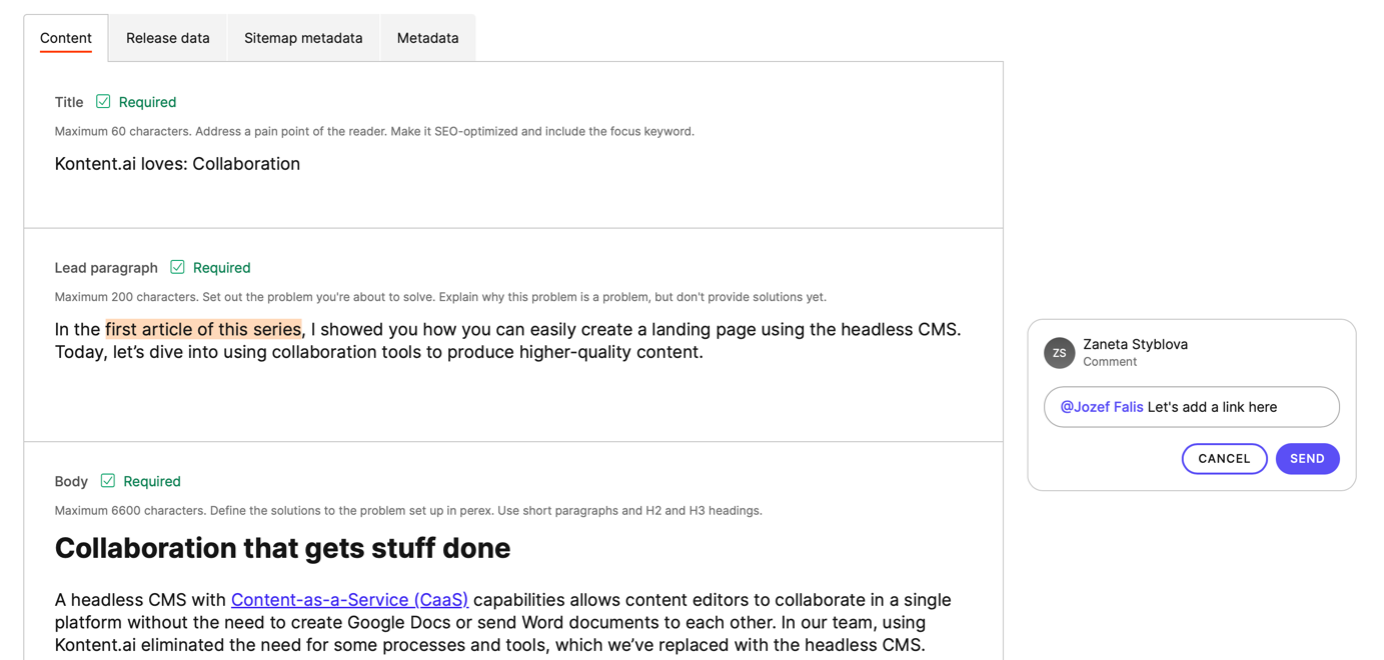
Using comments and suggestions keeps content creation collaborative. When working on your content pillars, the team can brainstorm, refine ideas, and discuss specific elements openly. This speeds up the creative process and also creates a more collaborative culture.
Create interconnected content pieces
When defining your content pillars, it’s important to understand how each one works and connects to the others. This understanding gives you the flexibility to mix different types of content, like videos, articles, or guides, effectively. Think of it like a chef knowing which ingredients work well together to create a balanced dish.
Your content model acts as the recipe. It structures content into reusable pieces with clear metadata, showing how different pieces relate and which can be combined. Just like a chef knows a squeeze of lime pairs with salmon but not steak, your content model guides how content fits together.
The content model sets the rules for how your brand uses and organizes content. It governs your content pillars and the topics within them, so getting it right is essential. Because it affects content across your organization, creating the content model should be a collaborative effort.
A strong content model clearly defines each pillar and its topics, helping teams understand how content can be reused, connected, and applied across different channels.
Consistently assess, review, and update content pillars
Content creation is constantly evolving, so it’s important to review and update your content pillars regularly. Keep an eye on shifting audience preferences and habits, and identify any parts of your content process that aren’t working efficiently to ensure your brand delivers its best work.
Regularly reviewing and updating your content pillars often involves tracking changes and understanding how your content evolves over time. In Kontent.ai, you can do that with versioning, which allows you to view older versions of your content items.
With that, team members can stay informed on content changes and improve performance by comparing versions. They can also restore older versions of content if they decide certain changes were unnecessary.
To maintain smooth operations across your content teams, Kontent.ai’s Mission Control provides a clear overview of production efficiency, helping ensure everyone is aligned and contributing effectively to high-quality content delivery.
Finally, tracking audience engagement and feedback is essential. By monitoring how your content performs and listening to your audience, you gain actionable insights that let you refine your content pillars and make sure your content resonates and performs at its best.
Content pillars help build structure and stay consistent
Content pillars are a big part of what makes digital marketing campaigns successful. Maintaining strong content strategies also requires:
Innovation
Adaptability
Relevance
Responsiveness to feedback
Strong understanding of the target audience’s preferences
Brands that leverage accurate audience insights and adapt their content pillars accordingly are better positioned to succeed. Combining well-defined content pillars with the flexible, decoupled architecture of a headless CMS like Kontent.ai gives teams unmatched control over creating, managing, and distributing content across multiple platforms.
Table of contents
The role of content pillars in shaping successful digital marketing campaigns
Understanding content pillars
The role of CMS in developing agile content pillars
A step-by-step guide to building content pillars with Kontent.ai
Content pillars help build structure and stay consistent
What if we told you there was a way to make your website a place that will always be relevant, no matter the season or the year? Two words—evergreen content. What does evergreen mean in marketing, and how do you make evergreen content? Let’s dive into it.
How can you create a cohesive experience for customers no matter what channel they’re on or what device they’re using? The answer is going omnichannel.
To structure a blog post, start with a strong headline, write a clear introduction, and break content into short paragraphs. Use descriptive subheadings, add visuals, and format for easy scanning. Don’t forget about linking and filling out the metadata. Want to go into more detail? Dive into this blog.
Lucie Simonova
Subscribe to the Kontent.ai newsletter
Get the hottest updates while they’re fresh! For more industry insights, follow our LinkedIn profile.